Conveyor Belt Classification and Selection Guide for Mining and Heavy Industry
Conveyor Belt Classification and Selection Guide for Mining and Heavy Industry
In integrated steel mills, mining operations, and heavy industrial facilities, the conveyor belt is the primary means of material transport. Whether moving raw iron ore, coke, limestone, sinter, return fines, or recycled materials, the belt conveyor system carries the entire material flow. Selecting the correct conveyor belt for each specific material is a decision that directly impacts production reliability and operational cost. This guide provides a practical overview of conveyor belt types and their optimal applications across the mining, steel, and heavy industrial sectors.
Nylon Conveyor Belt (NN)
Nylon conveyor belts use nylon fabric plies in both warp and weft directions, delivering a lightweight carcass with excellent elasticity, high tensile strength, and superior impact resistance. Their outstanding troughability makes them well-suited for medium to long-distance conveying, high-capacity transport, and high-speed applications.
Best for: Medium to long-distance ore and aggregate transport where belt flexibility and impact absorption are priorities.
Cotton and Polyester-Cotton Conveyor Belt
Conventional cotton or polyester-cotton fabric belts feature warp and weft yarns woven from cotton or blended fibers. These belts exhibit low elongation and strong adhesion between the fabric plies and rubber covers. Their dimensional stability under moderate heat makes them a practical choice for shorter conveying distances with lighter material loads.
Best for: Short-distance transport of medium-size ores, raw coal, coke, gravel, and powders across coal mines, ports, metallurgical plants, power stations, chemical facilities, and cement works.
The standard construction consists of multiple rubber-coated fabric plies laminated together with performance-specific cover rubber compounds, all bonded through vulcanization. This proven design remains the economical choice for general-purpose material handling.
Polyester Conveyor Belt (EP)
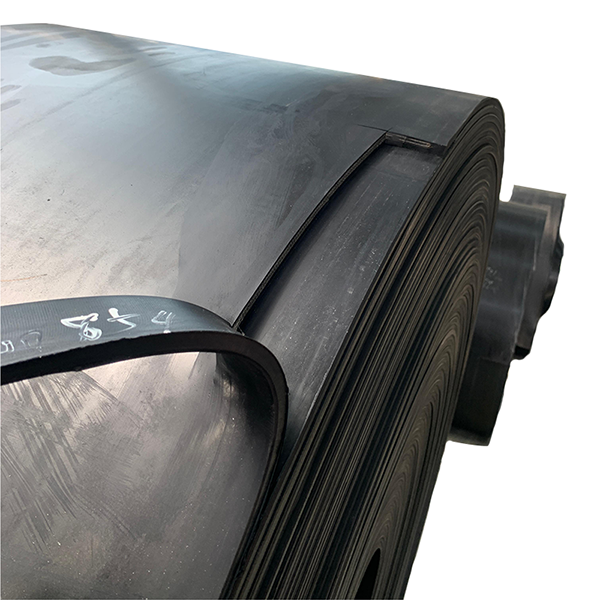
Polyester conveyor belts, also known as EP belts, use a hybrid carcass with polyester fibers in the warp direction and nylon fibers in the weft. This combination delivers the best of both materials: the high modulus and low elongation of polyester, combined with the impact toughness and troughability of nylon.
Key advantages include:
Lightweight carcass with high tensile modulus
Very low elongation under load, allowing lower safety factors in design
Excellent impact resistance and troughing characteristics
Strong resistance to moisture and insect damage
Superior dimensional stability under tension
Best for: Medium to long-distance, high-capacity, high-speed conveying where minimal belt stretch is critical to maintaining tracking performance.
Heat-Resistant Conveyor Belt
Steel mills and foundries present a fundamental challenge: conveying materials at temperatures that would rapidly degrade conventional rubber compounds. Heat-resistant conveyor belts address this with specially formulated cover rubber.
Two distinct performance tiers are available:
Standard Heat-Resistant (up to 150°C): Uses EPDM, SBR, or chlorobutyl rubber compounds for both cover and cushion layers. The carcass is typically built with cotton or polyester fabric. Suitable for coke, steel castings, and cement clinker at sustained operating temperatures up to 150°C.
High-Temperature Resistant (up to 250°C): Incorporates EPDM or SBR cover compounds capable of withstanding short-duration exposure up to 250°C, with sustained operation below 180°C. High-strength, high-permeability polyester or cotton fabric forms the tensile layer. Heat-resistant glass fabric can be inserted between the cover and carcass layers to provide an additional thermal barrier and extend belt service life. These belts exhibit minimal elongation and excellent abrasion performance under high-temperature conditions.
Best for: Sinter, hot coke, cement clinker, hot castings, and foundry applications in cement plants, coking facilities, metallurgical operations, and steel mills.
Abrasion-Resistant Conveyor Belt
Mining environments subject conveyor belts to relentless abrasion from sharp-edged, heavy, and hard materials. Abrasion-resistant conveyor belts are engineered specifically for these punishing conditions. Constructed with cotton, nylon, or polyester fabric carcasses and formulated through calendering, building, and vulcanization processes, these belts deliver significantly extended service life under high-wear operating conditions.
Best for: Ore and coal transport in mining operations where material characteristics cause accelerated cover wear. The right abrasion-resistant specification reduces replacement frequency and the associated cost of downtime.
Ultra-Abrasion-Resistant High-Strength Conveyor Belt
For the most demanding material handling applications, ultra-abrasion-resistant high-strength belts represent a step-change beyond conventional wear-resistant formulations. These belts employ advanced rubber compounding technology that simultaneously improves abrasion resistance and tensile strength — breaking the traditional trade-off between wear life and mechanical performance.
The extended service life directly reduces belt replacement frequency and the costly production stoppages associated with belt changeouts. They include variants such as industrial rubber sheets, plain rubber sheets, fabric-inserted sheets, textured-surface sheets, and oil-resistant sheets.
Best for: Transporting large-size, highly abrasive ores at high belt speeds. Ideal for mines, ports, power plants, metallurgical facilities, chemical plants, and coal operations running medium to long-distance conveyor lines.
How to Select the Right Conveyor Belt
Choosing the optimal conveyor belt requires evaluating four interacting factors:
Material characteristics — particle size, shape, abrasiveness, temperature, moisture content, and chemical reactivity
Conveying distance and speed — longer distances and higher speeds demand lower-elongation carcass materials like polyester or steel wire
Capacity and load — heavier loads require higher tensile strength ratings and appropriate safety factors
Operating environment — temperature extremes, chemical exposure, moisture, and fire safety requirements dictate cover rubber formulation
A well-matched conveyor belt not only ensures reliable operation but also substantially lowers the total cost of ownership through reduced maintenance, fewer replacements, and minimized unplanned downtime. At Xiamen Mining Conveyor Belt, we supply the complete range — from nylon and polyester belts to heat-resistant, abrasion-resistant, and ultra-high-strength specifications — all manufactured to ISO9001 quality standards for the world's most demanding material handling environments.